Blooket has transformed classroom engagement into an addictive game-show experience, but with popularity comes exploitation. If you’ve searched for “Blooket bot,” you’re likely a student seeking an unfair advantage, an educator worried about cheating, or a developer curious about game automation. This comprehensive guide cuts through the noise to deliver the truth about Blooket bots, how they work, why they’re problematic, detection methods educators use, and legitimate alternatives that actually enhance learning without compromising integrity.
What Is a Blooket Bot? Understanding Game Automation
A Blooket bot is an automated program designed to play Blooket games without human interaction. These scripts manipulate the game’s client-side code to auto-answer questions, farm tokens, or flood game lobbies with fake players.
Three Primary Types of Blooket Bots
- Auto-Answer Bots – Scripts that extract correct answers from the game’s JavaScript files or use optical character recognition (OCR) to identify questions and select answers instantly
- Token Farming Bots – Automation tools that repeatedly play solo games to accumulate Blooket tokens for unlocking cosmetics
- Lobby Flooding Bots – Programs that join games with multiple fake accounts simultaneously, disrupting legitimate gameplay
Technical Reality: Most Blooket bots operate through browser console injection or browser extensions that modify the Document Object Model (DOM) in real-time. They exploit the fact that Blooket, like many web-based educational games, processes game logic partially on the client side for performance reasons.
How Blooket Bots Actually Work: The Technical Breakdown
Understanding the mechanics helps both educators detect cheating and students recognize why these tools undermine learning.
Client-Side Exploitation Methods
JavaScript Console Injection: The most common method involves pasting code directly into the browser’s developer console (F12 on most browsers). Since Blooket runs in the browser, malicious scripts can:
- Access the game state stored in browser memory
- Read question data before it’s displayed
- Automatically trigger answer selection functions
- Bypass timing mechanisms
Browser Extension Manipulation: More sophisticated bots package their code as browser extensions that:
- Hook into Blooket’s API calls
- Intercept network traffic to read questions
- Modify outgoing responses to always send correct answers
- Operate persistently across multiple game sessions
GitHub Repository Distribution: Most Blooket bot code circulates through GitHub repositories with names like “Blooket Hack,” “Blooket Cheats,” or “Blooket Bot 2026.” These repositories typically contain:
- Pre-written JavaScript files
- Installation instructions for non-technical users
- Bookmarklets that execute code with one click
- Discord servers for troubleshooting and updates
Why These Bots Function (And Why They Shouldn’t)
Blooket’s architecture prioritizes speed and engagement over anti-cheat measures because it’s designed for educational environments built on trust. The game validates answers client-side before sending results to servers, creating an exploitable window.
Legal and Ethical Implications: Why Using Blooket Bots Is Problematic
The consequences of using automation tools extend far beyond a single game.
Terms of Service Violations
Using bots directly violates Blocket’s Terms of Service, which explicitly prohibit:
- Automated gameplay
- Modification of game code
- Creation of multiple accounts for unfair advantages
- Distribution of cheating tools
Enforcement consequences include permanent account bans, IP address blocks, and potential school disciplinary action if administrators are notified.
Academic Integrity Concerns
For students, using bots constitutes academic dishonesty equivalent to:
- Plagiarism on written assignments
- Using unauthorized materials during exams
- Falsifying laboratory data
Many schools have honor codes that result in failing grades, parent conferences, or academic probation for cheating violations even in “just a game.”
The Learning Paradox
Educational research consistently shows that retrieval practice (actively recalling information) strengthens long-term retention. Using bots eliminates this cognitive process, meaning students:
- Don’t encode information into memory
- Miss opportunities for spaced repetition
- Fail to identify knowledge gaps
- Perform poorly on actual assessments
Expert perspective: Dr. Henry Roediger III’s research on the “testing effect” demonstrates that the struggle to retrieve information, even when difficult, produces superior learning outcomes compared to passive review.
How Teachers Detect Blooket Bot Usage: Advanced Detection Methods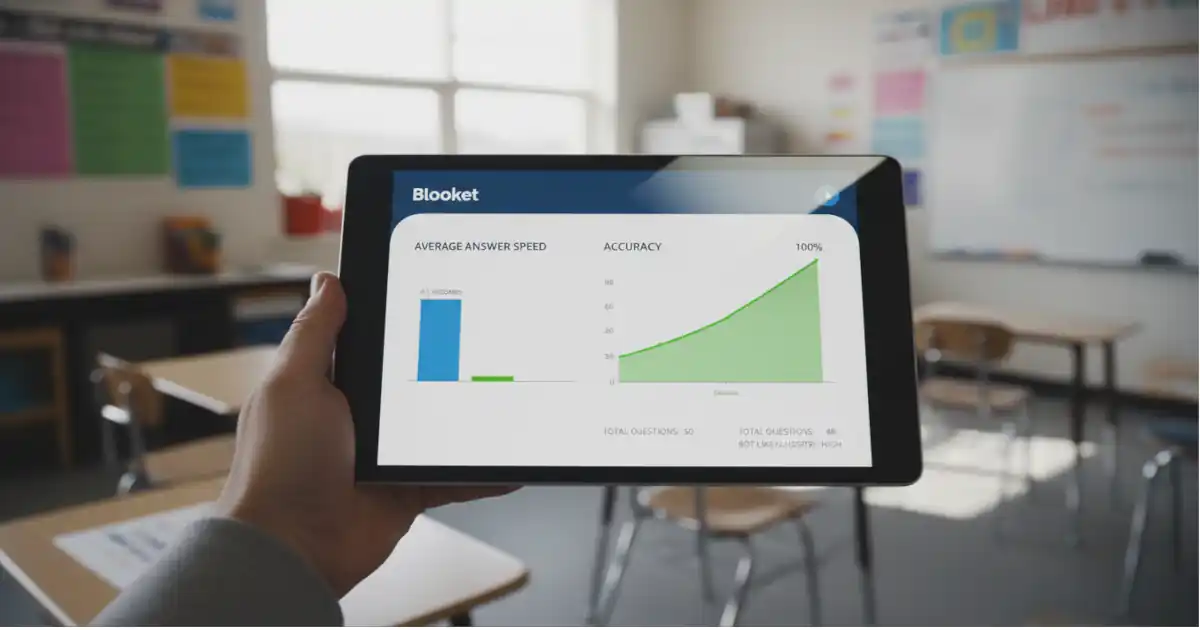
Educators have developed sophisticated techniques to identify automated gameplay.
Statistical Pattern Analysis
Impossible performance metrics:
- Answer speeds consistently under 0.5 seconds (faster than human reaction time)
- Perfect accuracy across hundreds of questions
- Identical performance across multiple game modes
- No variation in response patterns
Blooket’s built-in analytics flag accounts that exhibit these statistical anomalies, creating reports for teachers.
Behavioral Indicators
Teachers monitor for:
- Students who excel in Blooket but struggle with paper assessments
- Sudden performance improvements without corresponding grade changes
- Visible console windows or suspicious browser extensions during gameplay
- Multiple students using identical answer patterns (suggesting shared bot code)
Technical Monitoring
Advanced educators use:
- Classroom management software that takes screenshots of student devices
- Network traffic analysis to detect unusual API patterns
- Browser extension audits during supervised gameplay
- Lockdown browsers that prevent console access
The “Question Variant” Strategy
Some teachers create custom question sets with intentional variations that bots can’t detect:
- Questions with images requiring visual interpretation
- Context-dependent questions that reference previous answers
- Time-based questions that require reading passages
- Questions with deliberately similar wrong answers
Popular Blooket Bot Sources and Why You Should Avoid Them
While we won’t link to these tools directly, awareness helps educators understand the landscape.
GitHub Repositories
Repositories like “glixzzy/blooket-hack” and similar projects contain:
- Dozens of pre-built “hacks” for different game modes
- Community-contributed code updates
- Instructions for bypassing basic detection
Critical warning: These repositories often contain:
- Outdated code that no longer functions
- Malicious scripts that steal account credentials
- Keyloggers disguised as bot code
- Cryptocurrency miners that hijack computer resources
Discord Communities
Bot distribution on Discord servers promises:
- “Undetectable” versions of automation tools
- Real-time support for troubleshooting
- Premium versions with additional features
Reality check: Many of these communities:
- Require personal information for access
- Distribute malware through file-sharing
- Sell personal data to third parties
- Expose minors to inappropriate content
Browser Extension Stores
Some extensions in Chrome Web Store or similar platforms claim to “enhance” Blooket but actually:
- Request excessive permissions to read all browsing data
- Inject advertisements into web pages
- Track browsing history for marketing purposes
- Violate store policies (and get removed frequently)
Legitimate Alternatives: How to Excel at Blooket Without Cheating
These evidence-based strategies improve performance ethically while actually enhancing learning.
Active Studying Techniques
Spaced repetition systems:
- Use apps like Anki or Quizlet to review material days before Blooket games
- Create personal flashcards from class notes
- Practice retrieval at increasing intervals (1 day, 3 days, 1 week)
Cornell note-taking method:
- Divide notes into cues, notes, and summary sections
- Turn cues into potential Blooket questions
- Review summaries before gameplay
Game Mode Optimization
Tower Defense strategy:
- Prioritize accuracy over speed in early rounds
- Use earned coins strategically on defensive towers
- Learn question patterns from previous games
Gold Quest tactics:
- Answer initial questions correctly to build multipliers
- Trade low-risk chests for consistent points
- Swap difficult questions strategically
Collaborative Learning
Study groups that:
- Create practice Blooket sets for each other
- Quiz one another on difficult concepts
- Share mnemonic devices and memory techniques
- Review teacher feedback collectively
Technology-Assisted Learning (Legitimate)
Blooket’s built-in tools:
- Host private practice games in Solo mode
- Review question sets in “Flashcard” mode
- Use Homework mode for self-paced learning
- Analyze personal statistics to identify weak areas
Educational browser extensions (approved by teachers):
- Grammar checkers for writing-based questions
- Dictionary tools for vocabulary building
- Note-taking extensions that don’t interfere with gameplay
For Educators: Preventing and Addressing Bot Usage
Teachers can maintain game integrity through proactive measures.
Preventive Strategies
Question set design:
- Include questions requiring critical thinking, not just recall
- Use image-based questions that bots can’t easily parse
- Implement question randomization
- Create decoy answers that sound plausible
Supervised gameplay:
- Conduct Blooket sessions during class time with screens visible
- Use projection systems where students see each other’s games
- Implement “phone-free” policies during competitive matches
- Rotate seating to prevent screen sharing
Detection and Response Protocols
When bot usage is suspected:
- Document the evidence (screenshots, analytics reports, performance data)
- Conference privately with the student
- Provide an opportunity for explanation
- Follow school policy on academic integrity violations
- Notify parents/guardians as appropriate
Educational approach:
- Explain why the behavior undermines their own learning
- Discuss the broader implications for academic integrity
- Offer remediation opportunities
- Provide support for students who feel pressure to cheat
Platform-Level Solutions
Blooket Plus features for educators:
- Enhanced analytics that flag suspicious patterns
- Question timers that prevent instant answers
- Randomized question distribution
- Answer feedback delay options
Integration with learning management systems:
- Canvas, Google Classroom, or Schoology grade syncing
- Assessment correlation analysis
- Progress tracking across multiple platforms
The Future of Educational Game Security
The arms race between bot developers and educational platforms continues evolving.
Emerging Anti-Cheat Technologies
- Mouse movement pattern analysis
- Typing rhythm recognition
- Scroll behavior monitoring
- Click timing variations
Server-side validation:
- Moving game logic entirely to servers
- Real-time answer verification
- Latency analysis to detect automation
- Multi-factor authentication for high-stakes games
AI-Powered Proctoring
Machine learning systems that:
- Analyze webcam footage for suspicious behavior
- Detect multiple devices accessing the same game
- Identify coordinated cheating patterns across classrooms
- Provide probabilistic cheating scores
Privacy considerations: These technologies raise important questions about student privacy, requiring transparent policies and opt-in consent.
Blooket Bot Myths vs. Reality
Separating fact from fiction in online claims.
Myth: “Bots are undetectable if you answer a few questions wrong intentionally.”
Reality: Statistical analysis detects patterns even with intentional errors—the consistency of timing and error distribution reveals automation.
Myth: “Using bots is a victimless act that only affects my own learning.”
Reality: Bot usage in competitive modes disadvantages honest players, undermines teacher assessment validity, and can result in misallocated educational resources.
Myth: “Blooket doesn’t care about bot usag.e”
Reality: The platform actively updates detection mechanisms, bans accounts, and works with schools to address systematic cheating.
Myth: “Bots help me learn faster by showing correct answer.s”
Reality: Passive observation of correct answers produces minimal learning compared to effortful retrieval practice.
Conclusion: The Choice Between Shortcuts and Success
Blooket bots represent a technological shortcut that ultimately sabotages the very outcome students seek genuine knowledge and academic success. While automation tools exploit temporary vulnerabilities in game architecture, they create permanent gaps in learning that manifest during actual assessments.
For students: the cognitive effort required to succeed at Blooket without bots is precisely the effort that builds lasting knowledge. The temporary ranking boost from automation comes at the cost of real competency.
For educators: understanding bot mechanics enables better game design, more effective detection, and meaningful conversations about academic integrity in digital environments.
The most effective “Blooket hack” remains the oldest educational strategy: deliberate practice, spaced repetition, and genuine engagement with material. These time-tested approaches not only improve Blooket performance but also transfer to every academic and professional challenge students will face.
Frequently Asked Questions (FAQs)
What happens if I get caught using a Blooket bot?
Consequences typically include account suspension, failing grades for associated assignments, parent notification, and potential honor code violations. Repeat offenses may result in permanent bans and school-wide disciplinary action.
Are there legal Blooket bots or automation tools?
No. All automation tools violate Blooket’s Terms of Service regardless of their source or marketing claims. Legitimate study aids don’t automate gameplay—they enhance preparation.
Can teachers actually detect bot usage?
Yes. Teachers use statistical analysis, behavioral monitoring, performance correlation with other assessments, and built-in Blooket analytics that flag anomalous patterns like sub-second answer times and perfect accuracy.
Do Blooket bots contain viruses or malware?
Many do. Bot repositories and Discord communities frequently distribute code containing keyloggers, credential stealers, cryptocurrency miners, and other malicious payloads disguised as automation tools.
How can I improve my Blooket performance legitimately?
Use spaced repetition study systems, practice in Solo mode, create personal flashcards, join study groups, review incorrect answers, and employ active recall techniques rather than passive re-reading.
Will using a VPN hide bot usage?
No. Detection focuses on gameplay patterns (answer speed, accuracy, response consistency) rather than IP addresses. VPNs don’t mask the statistical anomalies that identify automated gameplay.
Are paid “premium” Blooket bots safer or more effective?
No. Paid bots are scams that either don’t work, contain more sophisticated malware, or steal payment information. All bots violate platform rules regardless of cost, and “undetectable” claims are false marketing.
Read more knowledgeable blogs on: blooketjoiner.com